Same scores, a third less thinking.
DeepSeek released V4.1 Flash 1017 ten days ago: stronger, and already more concise than the original V4.1 Flash. Today we're releasing DeepSeek-V4.1-Flash-1017-AZ-Focus, open weights with the second-guessing taken out. It thinks about a third less, and lands within run-to-run variation of the original on every benchmark we ran: our closest match to stock yet.
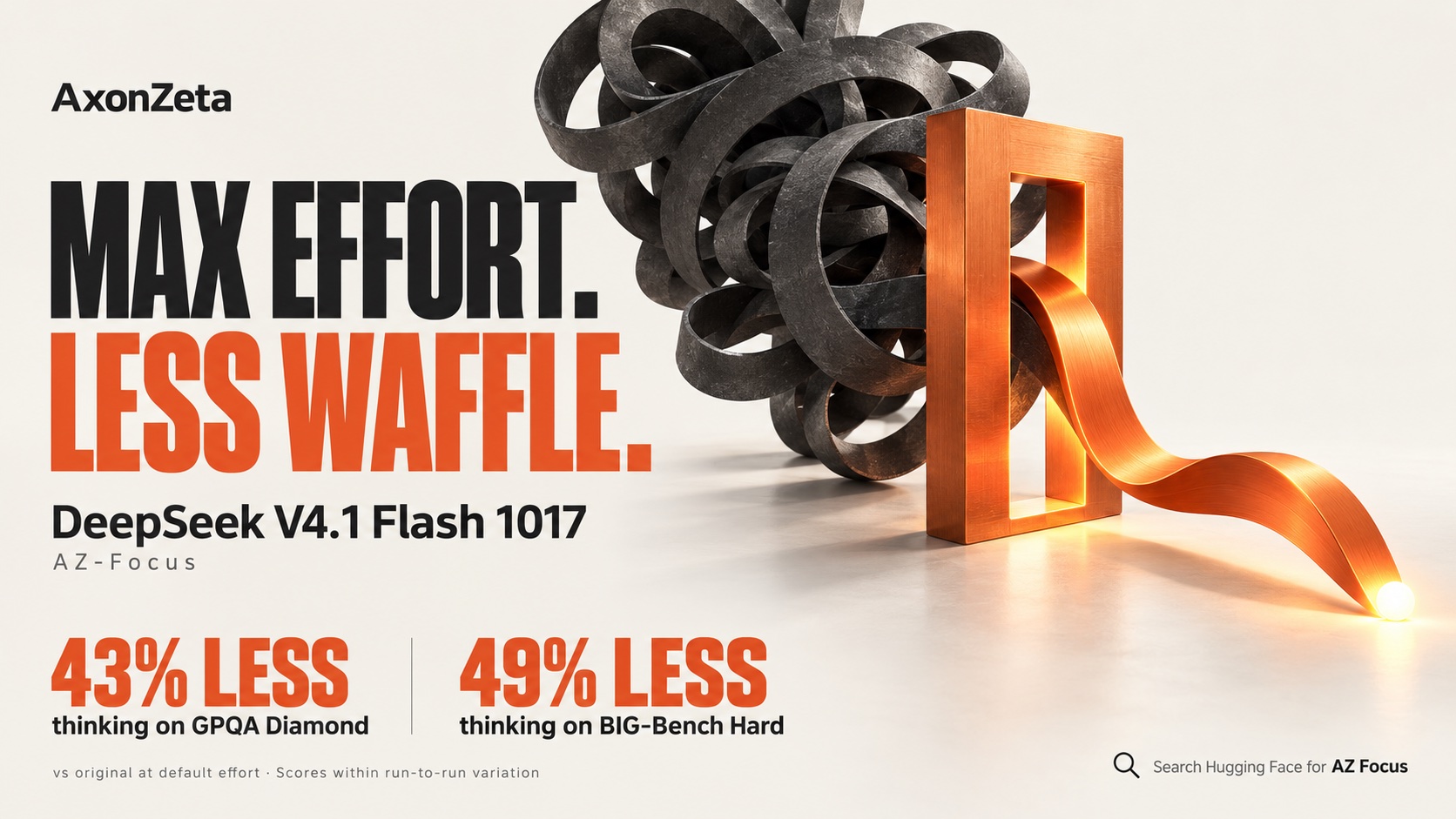
Matched benchmark. Unmatched performance
Our first DeepSeek release halved the thinking, but gave up some accuracy on competition maths. For 1017 we set a stricter bar: no benchmark should move beyond run-to-run variation. Accuracy and mean thinking tokens per item at DeepSeek's default effort:
| Benchmark | Original | AZ-Focus | Thinking |
|---|---|---|---|
| GPQA Diamond (2 runs) | 91.4% · 6,629 | 90.9% · 3,777 | 43% less |
| BIG-Bench Hard | 82.0% · 709 | 84.1% · 359 | 49% less |
| MMLU-Pro | 89.2% · 1,445 | 88.8% · 953 | 34% less |
| HumanEval | 98.2% · 891 | 98.8% · 552 | 38% less |
| MATH-500 + GSM8K, held-out (3 runs) | 95.0% | 95.0% | 25–32% less |
| AIME 2025 (4 runs) | 97.5% · 6,188 | 95.8% · 4,997 | 19% less |
Two benchmarks come out ahead (BIG-Bench Hard and HumanEval), the held-out maths set is level at 95.0%, and the rest are within a point or two. AIME 2025 is the closest call: 115 against 117 of 120 answers correct over four runs, with both models missing the same hard problems. That is within run-to-run variation, but it is the one place the original stays slightly ahead.
Most savings on the longest questions
GPQA Diamond shows where the thinking goes. Given room to finish, the original spends 6,629 thinking tokens per graduate-level science question, and some of its answers run past 32,000 tokens. AZ-Focus answers the same questions in 3,777 tokens on average, with the same accuracy, and none of its answers came close to the 128k limit.
On held-out maths, it backtracks about six times less often (0.4 against 2.5 times per 1,000 thinking tokens), at the same 95.0% accuracy. AZ-Focus still reasons step by step and still checks its work. It just doesn't go round in circles.
Less thinking at every effort setting
DeepSeek's reasoning-effort dial already lets you trade thinking for speed, so we measured both models at the same settings. AZ-Focus thinks 27–49% less at each one, with accuracy level on average:
The two combine. At effort 25, AZ-Focus answers MMLU-Pro with 389 thinking tokens on average, against 704 for the original at the same setting, both at 88.2% accuracy.
Just as strong as an agent
Coding agents need the model's careful checking: running tests, reading output, fixing what fails. We ran both models twice on the first 100 tasks of SWE-bench Verified with mini-SWE-agent, at the default effort:
| SWE-bench Verified, first 100 tasks | Original | AZ-Focus |
|---|---|---|
| Tasks resolved, run 1 · run 2 | 94 · 94 | 94 · 93 |
| Steps per task (mean) | 18.0 | 17.8 |
| Output tokens per task (mean) | 6,582 | 5,977 |
Half a task apart on average, with no empty patches in any run: the same agentic coding, with slightly less output.
Get it
DeepSeek-V4.1-Flash-1017-AZ-Focus is open, under the MIT licence like the original, and a drop-in replacement: the same files, formats (MXFP4 / FP8), chat template and reasoning-effort dial. Serve it with the same engine and settings.
- Weights on Hugging Face.
- Full results: the model page.
- Still on the original V4.1 Flash? DeepSeek-V4.1-Flash-AZ-Focusis the version for that model.
What this does and doesn't show
- Benchmarks are compared at DeepSeek's recommended sampling (temperature 1.0, top-p 0.95), so single runs vary. We ran GPQA twice, AIME four times, the held-out maths set three times and SWE-bench twice for both models.
- Hard competition maths is slightly behind (AIME 2025 115 vs 117 of 120; MATH level 5 87.6% vs 89.6%), within run-to-run variation. If olympiad-style maths is your main use, you may prefer the original.
- Long multi-hour agent sessions, other languages and very long contexts haven't been measured separately yet.
- AZ-Focus is designed to change how long the model thinks, not what it will or won't do.