Max effort, less waffle.
Meta's Muse Glimmer 30B lets you choose how hard it thinks, from low to xhigh. Today we're releasing Muse-Glimmer-30B-AZ-Focus, open weights with the second-guessing turned down. You get xhigh results for fewer tokens than the original spends at its default setting.
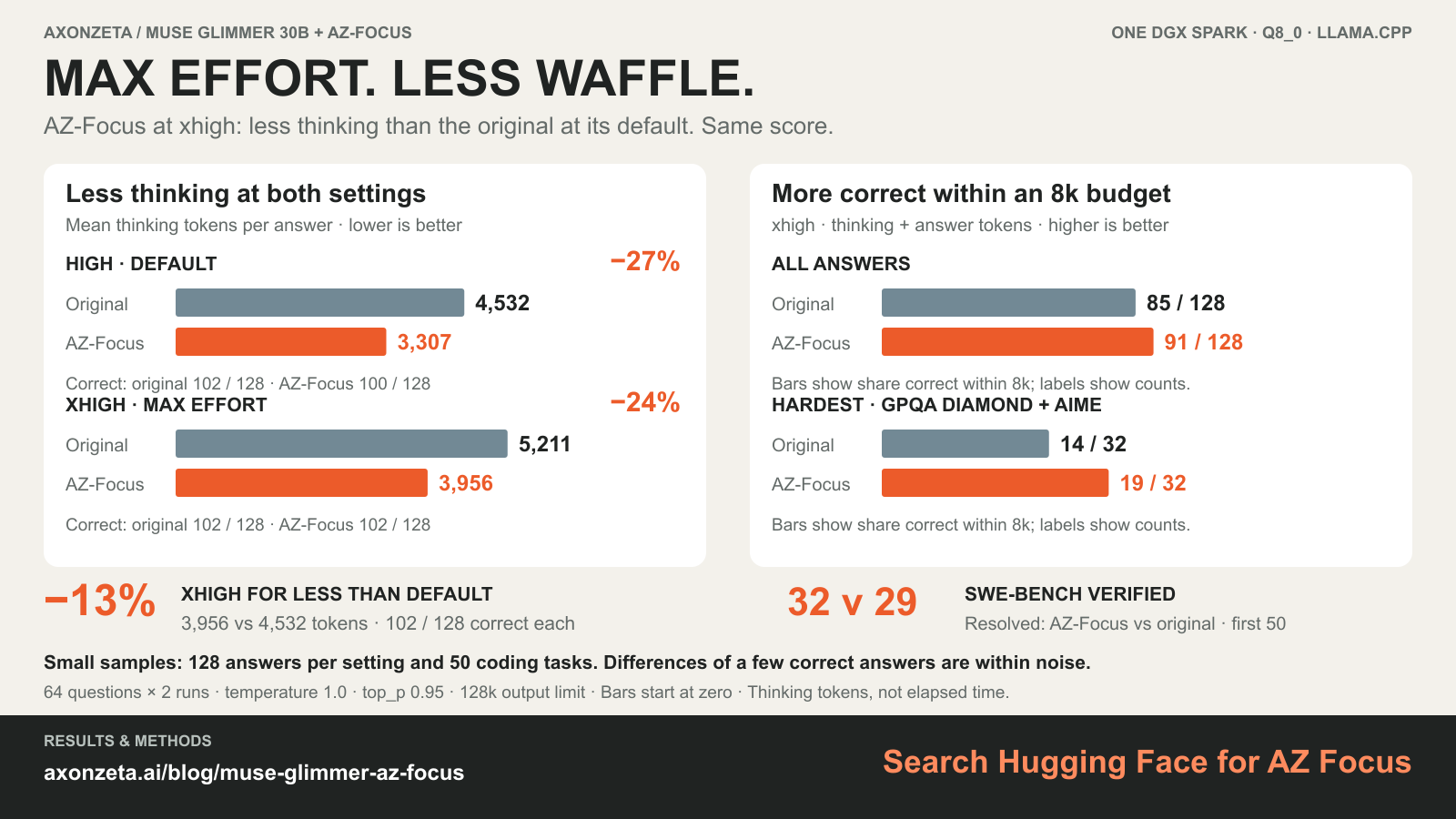
Biggest savings on the longest answers
AZ-Focus saves most where Muse Glimmer thinks longest. At the default setting its longest answer was 38,921 tokens, against 53,660 for the original, and on the hardest questions it spends far less time circling: 4,675 thinking tokens on average where it doesn't reach the answer, against 8,200 for the original.
That's where Glimmer's thinking goes. It's already quick on most questions, with a median answer of about 1,300 thinking tokens on our 64-question test set (MMLU-Pro, BIG-Bench Hard, GPQA Diamond and AIME 2025, each question answered twice). The longest 10% of answers account for 58% of all its thinking, and much of it is re-checking work already done: "Wait…", "Hmm…", "Actually…". AZ-Focus still reasons step by step and still checks its work. It just loops less.
Turned up to xhigh, still cheaper than the default
AZ-Focus cuts thinking at both of Muse Glimmer's thinking-heavy settings, by 27% at high and 24% at xhigh. At xhigh it uses fewer tokens than the original does at high, for the same 102 correct answers:
If you'd been running Muse Glimmer at high to keep answers quick, AZ-Focus at xhigh gives you the model's most thorough setting at a lower thinking cost.
More correct answers within a budget
Shorter answers pay off most when answers have to come back within a time or token budget. Counting an answer only if it is correct and finished within the budget, at xhigh:
At an 8k budget AZ-Focus gets 91 answers correct to the original's 85; on the hardest questions, 19 to 14. With no limit the two end level, as they should: AZ-Focus reaches the same answers, sooner.
Just as strong as an agent
Muse Glimmer is built for agentic work, so we checked that AZ-Focus keeps the careful checking a coding agent needs. We ran both models on the first 50 tasks of SWE-bench Verified with mini-SWE-agent, at the default reasoning strength:
| SWE-bench Verified, first 50 tasks | Original | AZ-Focus |
|---|---|---|
| Tasks resolved | 29 of 50 | 32 of 50 |
| Finished within the 100-step limit | 37 of 50 | 41 of 50 |
AZ-Focus resolved 32 tasks to the original's 29, finished more of them within the step limit, and took slightly fewer steps (67.4 per task on average, against 69.4). On 50 tasks the difference is within noise, so we read it as the same agentic coding, in slightly fewer steps.
Get it
Muse-Glimmer-30B-AZ-Focus is open, under Apache 2.0 like the original, and a drop-in replacement: the same files, chat template, reasoning strengths and vision encoder.
- BF16 on Hugging Face, for transformers and vLLM, or your own quantizations.
- GGUF for llama.cpp: Q8_0 (29.6 GB) and the vision projector.
- EXL3 for ExLlamaV3: 4.0 bpw, about 17 GB, for 24 GB GPUs. On all 30 AIME 2025 problems it thinks 19% less than the same build of the original, with 54 of 60 answers correct against 56.
- Full results: the model page.
What this does and doesn't show
- Small sets: 128 answers per setting and 50 coding tasks. Differences of a few answers are noise; the thinking reductions of 24–27% are the signal.
- Measured with thinking on, at high and xhigh, on Q8_0 GGUFs in llama.cpp with its default top-k (Meta recommends 64; both models were run the same way). Lower strengths, vision, other languages and very long contexts haven't been measured separately.
- AZ-Focus is designed to change how long the model thinks, not what it will or won't do. We haven't re-run Meta's safety evaluations; Meta's usage policy applies.